
Enderle & Moll (Germany)

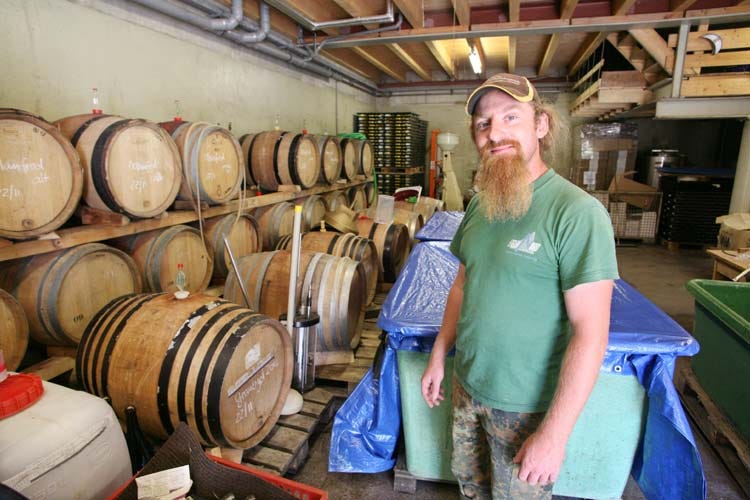
Sven Enderle
Münchweier (Baden-Württemberg)
Enderle & Moll is a fairly new winery set up by two young Germans in the Baden region, namely in the Black Forest foothills between Offenburg and Freiburg im Breisgau. Working from a 2-hectare surface, they’re pretty isolated in the region regarding their approach to winemaking and viticulture, choosing to let the vineyard live its life without fertilizers, pesticides and herbicides, and somehow taking parcels that commercially-driven family wineries tend to abandon because of lower yields.
On the cellar side they also work very differently from most of the trade around here, the wines are basically left by themselves uncorrected, including for the color of the Pinot Noir, and because of the striking difference with the “traditional” corrected wines of the area, they fearlessly bottle their wines as Deutscher Tafelwein (you understand German here, I guess) , an unprecedent rebellion in Germany. This reminds us of similarly demanding winegrowing work in France being rewarded by getting the supposedly-untouchable status of table wine (which has now almost become a blinker for real wines there).
I was tipped about Sven and Florian by my friend Surk-ki who runs the wine shop La Vincaillerie in Köln, thank you Sur-ki !
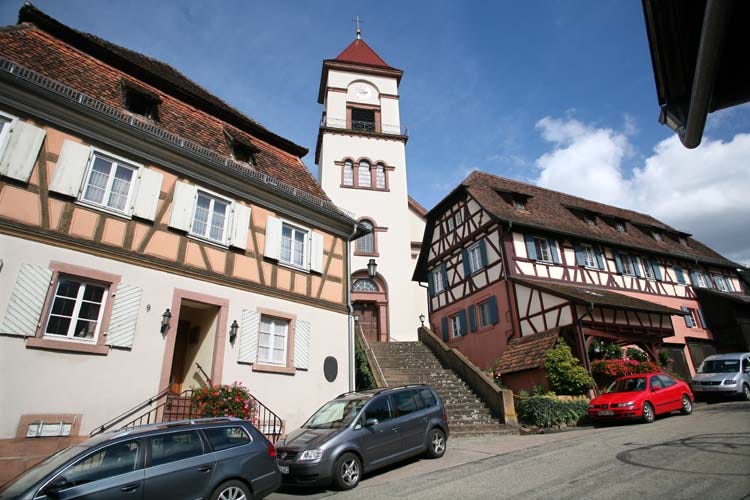
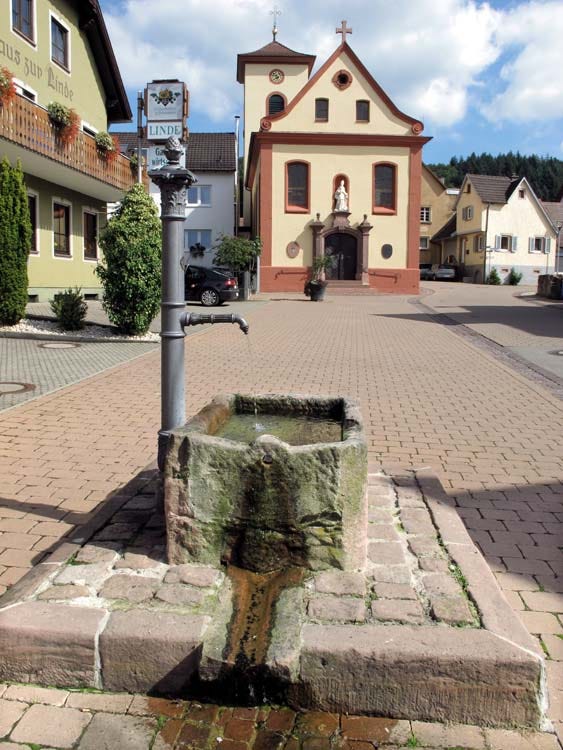
Münchweier is a charming village sitting on the first slopes of the Black Forest range, a region that mirrors Alsace’s own Vosges foothills, and here like in Alsace the villages have deep winemaking roots, every old house having had in the past its own micto winery and tools. Some villages are particularly worth the detour, like Gengenbach a few kilometers north, a gem of a village where I used to go regularly (and occasionally drink wine) when I was living in Strasbourg a few years ago.
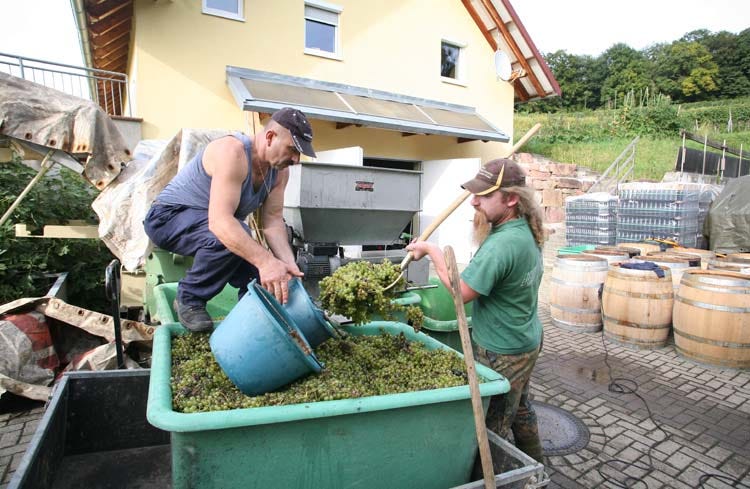
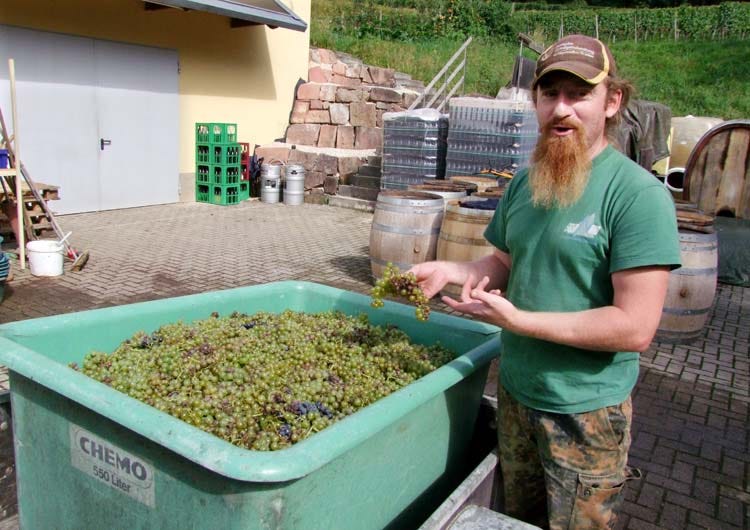
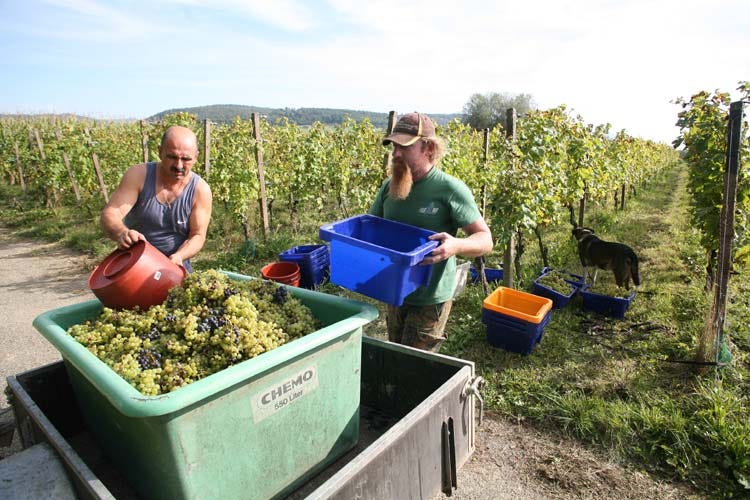
Unloading Müller-Thurgau grapes
I met Sven on a harvest day, the first of the season. He and a seasonal worker picked me in Wallburg, another cute village (pictures on both sides) close to Münchweier on their way to the winery with a load of white grapes. Sven had told me over the phone that this wasn’t supposed to be the beginning of the harvest for them (still scheduled for 2 or 3 weeks later) but they had a small parcel of Müller-Thurgau with incidences of grape worms and some rot, and if they didn’t harvest now they’d loose the whole grape load here before the planned harvest day. Sven and Florian are farming their vineyards organicly and they even refrain from doing all the sprayings sanctioned by the organic rules, which eventually led to the problems in this particular vineyard.
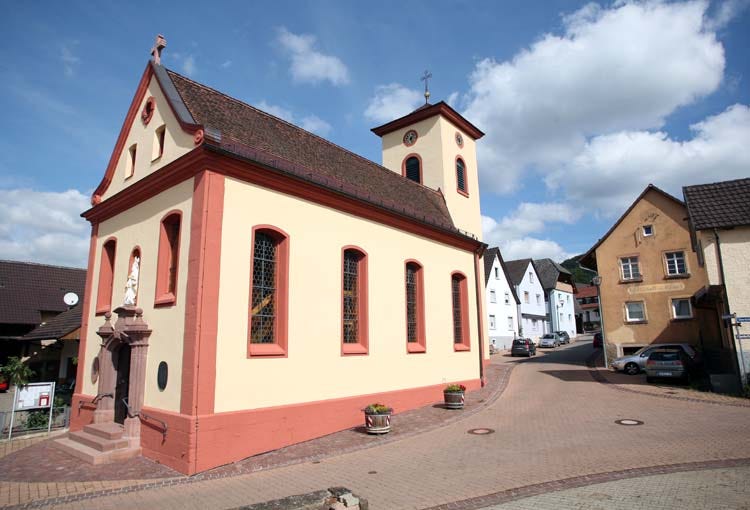
The region is known as being the home of the Münchweier-Wallburg-Schmieheim Winzergenossenschaft [cooperative], which was founded in 1971 and works on about 100 hectares belonging to 110 growers. This coop is the biggest on the Lahr area and with all the conventional growers bringing their grapes there, the vineyards of Sven and Florian bear the marks of their rebelliousness, an island of unbridled and happy plants in a sea of rows kept in check by herbicides and boosted by fertilizers.
We first speak about the varieties around here, and pinot noir holds a good place, but there are names I’m not familiar with, like Regent, an hybrid that was created in the late60s’ and is mold resistant. The people who created this hybrid wanted to limit the chemicals sprayings, but the variety doesn’t yield interesting wines. Sven notes that these last years have indeed been problematic because of difficult weather conditions, and a friend of his who farms conventionally near here says that he routinely now sprayed 13 times a year compared to 5 times 20 years ago. Sven himself sprayed 12 times, which is also a lot even if organic. Sven tells me about the different levels of organic certifications in Germany, the one inspired by Rudolf Steiner’s work, Demeter, forbidding the use of phosphoric acid (Phosphorsäure) while thesimply-organic certification allows it. At Enderle & Moll, Sven and Florian try to follow as much as possible a biodynamic farming but they’re not certified and they had to spray Phosphorsäure in the last two years because of difficult conditions in the vineyard.
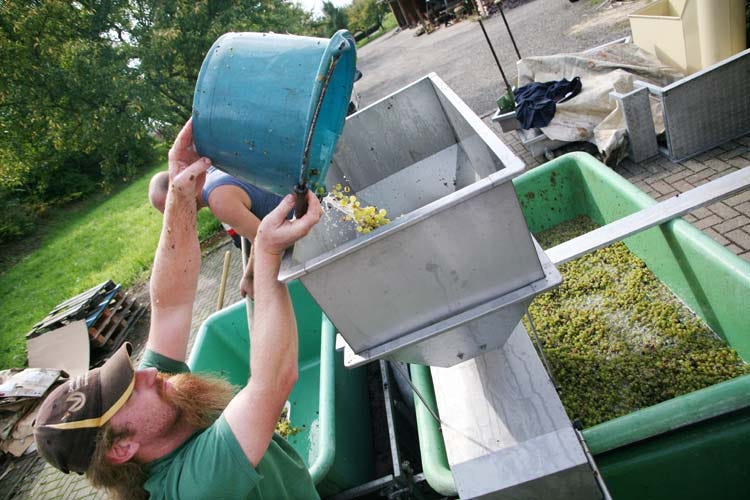
Last bucket
Speaking of their vineyard management and the way they work, letting grass grow, using a backpack sprayer for the treatments and artisanal tools in the facility, Sven says that this makes probably laugh the established wineries of the region, like the Bernhard Huber Weingut (winery) which has been rated until now as making Germany’s top pinot noir and where costly investments have been made along the years in technology. But one thing is the way Sven and Florian are doing it every day, and another thing is the wine that comes out of it, he says, and actually their own wine has recently fared much better than the one of this established winery in a Berlin tasting event, this was the Big Bottle Party 2013 at the Hotel Palace.
All the best German pinot noirs were at this wine tasting event at the Palace Hotel in Berlin (see the list of the participating Winzer), the ones of Bernard Huber plus the ones of Paul Fürst in Franken and Fritz Becker in Pfalz, and after all these Michelin-starred chefs and sommeliers attending the event tasted the different wines, they came to Sven and Florian and told them that their wines were really way above the other ones.
This is the kind of comment you like to hear, I guess, when you started without any backing and no encouragement from the region where you’re working.
Oddly, Sven says, they’re still not well known here in Germany while their work is aknowledged abroad and their wines are appreciated by foreign amateurs, like in the United States where they were imported for the very first vintage, and wine critics kept encouraging them, like Jancis Robinson who calls them cult producers.
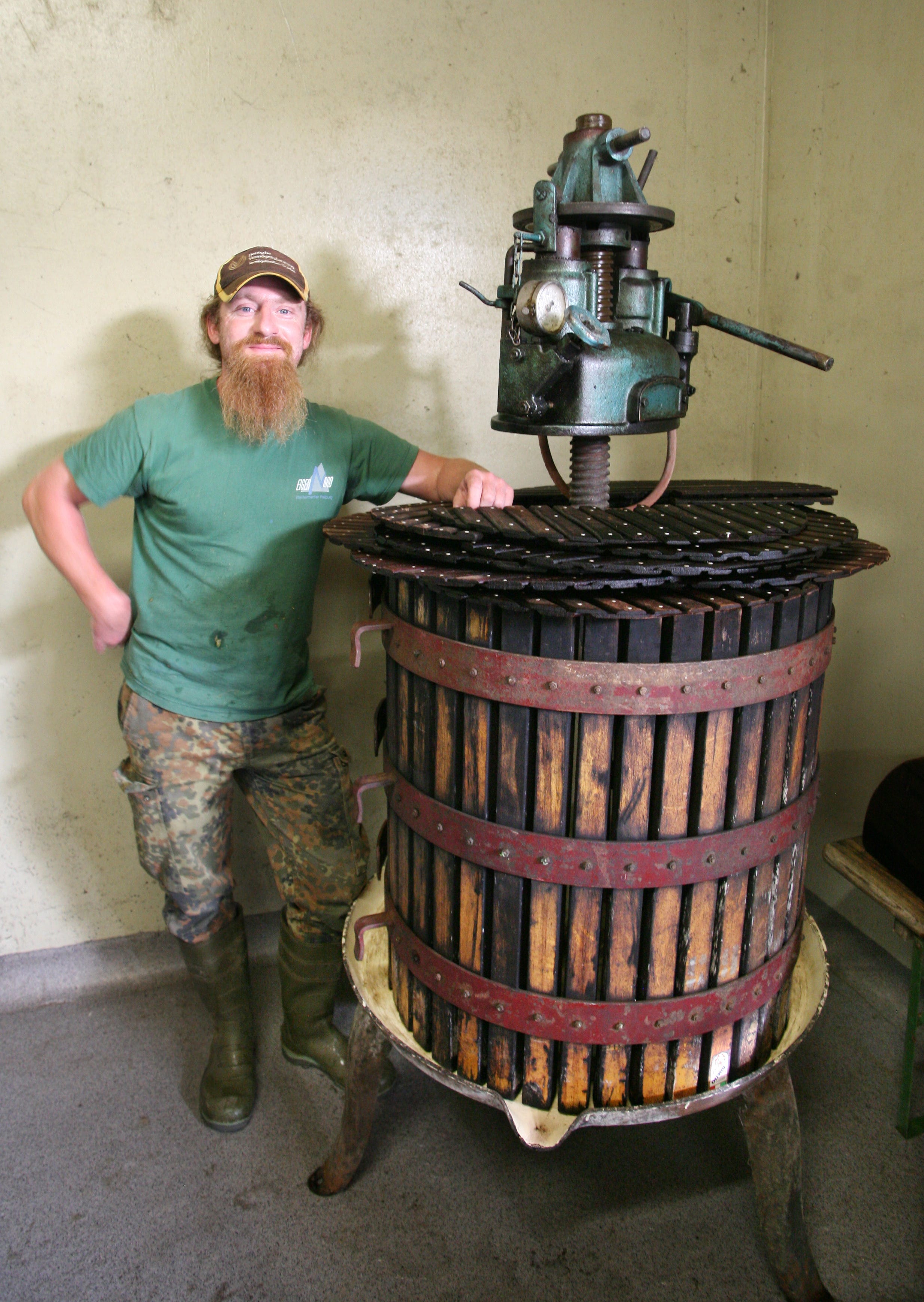
The basket press
Sven recounted me how it all began :
He and Florian met during their wine training in the Winzer Schule in Freiburg, a training where they alternated 1 week of courses with 5 weeks of work in wineries. Sven had his training at Bercher-Schmidt in Oberrotweil while Florian spent time at Weingut Höfflin near Bötzingen, both being in the old wine region of Kaiserstuhl between Freiburg and the Rhine. They went separate ways for a few years, Sven visited in between many vignerons in France beginning with Burgundy, Florian also worked here and there in France, particularly in the Languedoc. Sven is also a climber and he travelled to France for that purpose too, he told me that he is familiar with Auvergne for example and he was supposed to go there last year for this great natural-wine tasting of Les Dix Vins Cochons but couldn’t for some reason.
Sven and Florian, after finetuning their training, decided to set up this winery here in Baden, doing their first vintage in 2007. They were really working anonymously in this corner of Baden then, completely under the radar of wine-scouting sommeliers. One day in spring or mid 2008 a cork salesman walked in, he had heard that a new winery had opened shop and was interested in this potential new customer. There were two barrels of wine in the winery then, and Oliver Fischer (it was his name) who happened to be also a wine taster for the Pfalz region, looked around and spotted “Domaine Jayer-Gilles” printed on the casks (the domaine where they bought the vessels) and his interest was raised a notch, with also the basket press and other things that hinted about an unsusual artisan operation. So he tasted the wine and said right away that he had never tasted a pinot noir like this before in the region, there were characteristics that were typical of a pinot noir, put it in another dimension.
He asked for a few bottles, but Sven and Florian had only these two casks, so they filled 6 bottles which this visitor later gave to Lars Carlberg who was importing Mosel wines into the United States through Mosel Wine Merchant (now defunct). Lars came visiting Sven and Florian two days later and bought all the wine, which was sent to New York’s Chambers Street Wines. This unexpected chain of events made thus their wines instantly known on the New York market while Sven and Florian were still unknown by the wine trade people of their own region.
This basket press makes a beautiful job, Sven says, but people in the region turned them into flower pots. He’s pressing all hiw grapes with this, and if he works with a larger surface in the future, he has another basket press which is double this size, and hand powered, which he prefers to this hydraulic one.
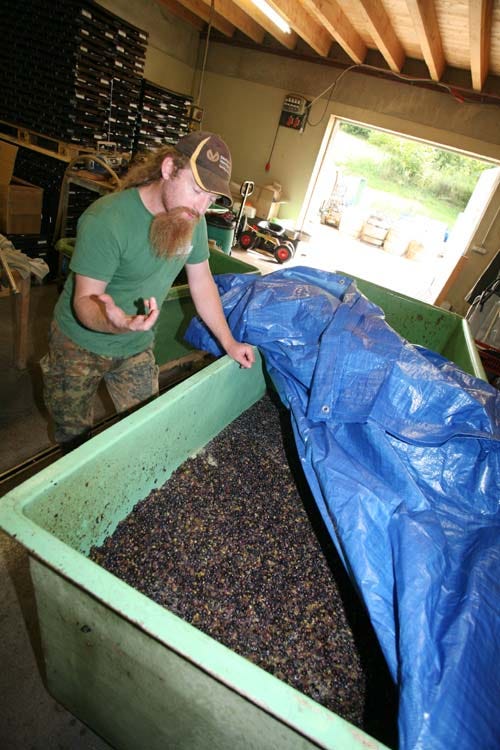
A fermenter of pinot noir
Sven says that they can’t copy Burgundy and they don’t try to, adding that these top-level terroirs over there are another world, and they just want to make pinot noirs wines (called Spätburgunder here) that express themselves gently and naturally. He lets other people in Germany trying to concentrate their wines and use enzymes and tannins for this purpose (and many of them work hard on their wines to make them look like Burgundies), but he considers that it is important to take the vineyard and the terroir as they come and make a wine that respects Nature.
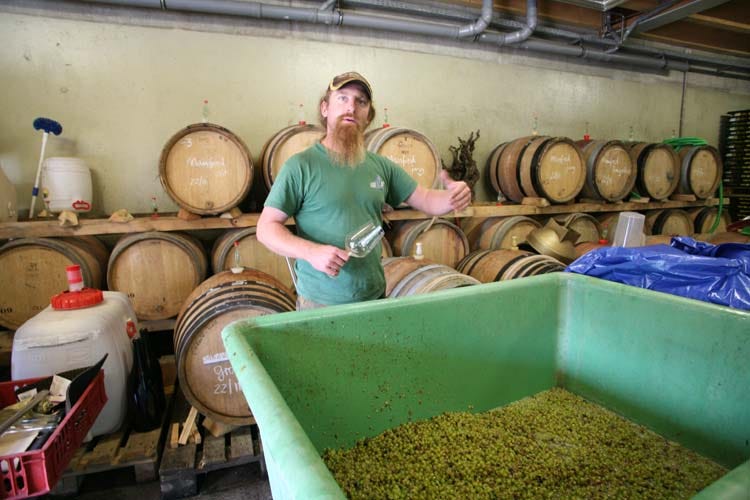
That’s why their pinots here are neither dark and overextracted, these wines are on the subtle-aromas side and freshness and they found their public among demanding amateurs. Stephen Bitterolf who is a wine buyer at Crush in New York writes in this profile about the contrast between this new generation of German vintners (Sven and Florian) and the older one making these big, inky, muscular profiles, lumbering with concentration and burning with alcohol. Right now since the closing down of Mosel Wine Merchant (the importer) they don’t sell abroad anymore and they begin to sell in Germany. They have also begun to sell their wines in a few good restaurants of the region.
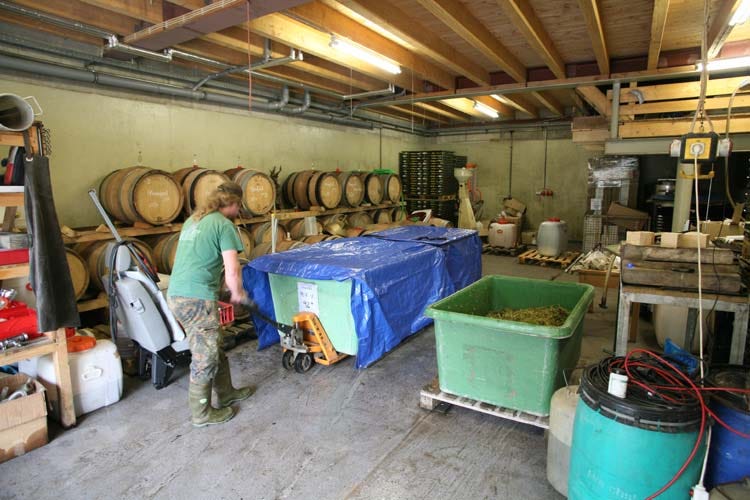
They had also to pick a small surface of pinot noir much sooner than planned, because of the rot endangering the small parcel. Sven says he’s put a bit of sulfur on the grapes because of this problem. The rest of the pinot noir will be harvested a couple of weeks later. They’ll make a rosé out of this early-picked pinot, leaving the grapes here until tomorrow and then pressing them. Sven says that speaking of rosés, he loves the one of Domaine de L’Horizon in the Languedoc by Thomas Teibert who happens to be a German expat.
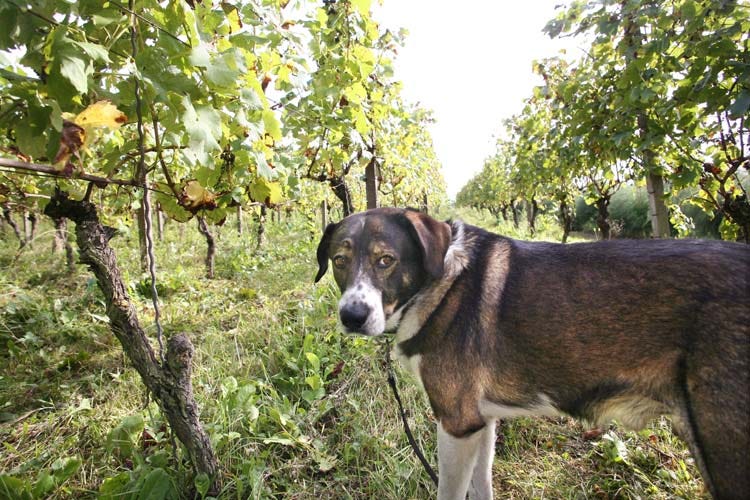
Florian’s dog in the vineyard
In the next future they’ll be able to sell more wine because a friend of his who is a very good grower in the region but doesn’t make wine from his vineyards is going to get associated with their winery and sell them his grapes. With his 7 hectares of wisely-farmed vineyards (no fertilizers used there), Sven and Florian will work on a total surface of about 10 hectares. Sven says that if this grower, Manfred Enderle (they’re not related, the name is very common in the region), was making wine he would be among the top three vintners of the region in less than 5 years because his vineyard work is so good, the vineyards are all older than 50 or 60. One third of this surface is pinot noir, the rest being pinot blanc and pinot gris.
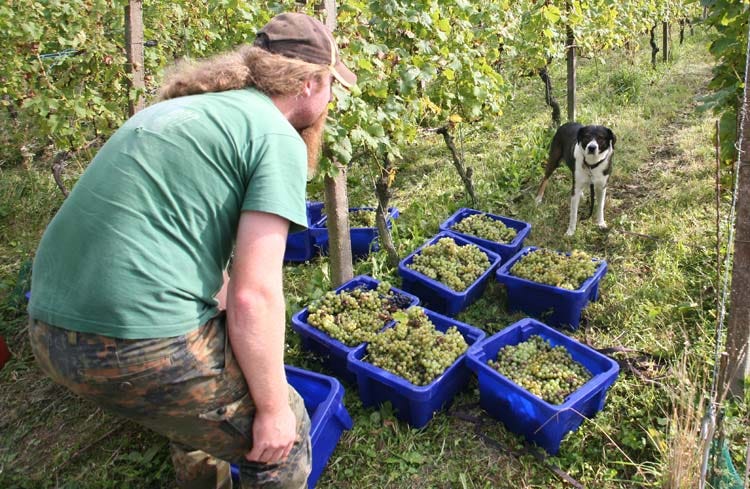
Even at the time Manfred’s father was at the wheel, conventional growers considered him as a bit strange because he wasn’t following the chemical, high-yields routine, but Sven says that the grapes he’s producing are fantastic, and when you walk through the vinenard you’re impressed by the healthy feel of the plants. When other vineyards have a foliage with dark green colors that hint that they’re boosted by fertilizers, his own are more pale because they live with the natural resources of the soil, they’re not on steroids.
Sven and Florian’s own vineyard also stand out among the conventional vineyards, not only because of the grass but because of this paler foliage thing. You can see one of their vineyards (Müller-Thurgau) on the picture above with Florian’s deep-staring dog, a dog who has its own mind, says Sven.
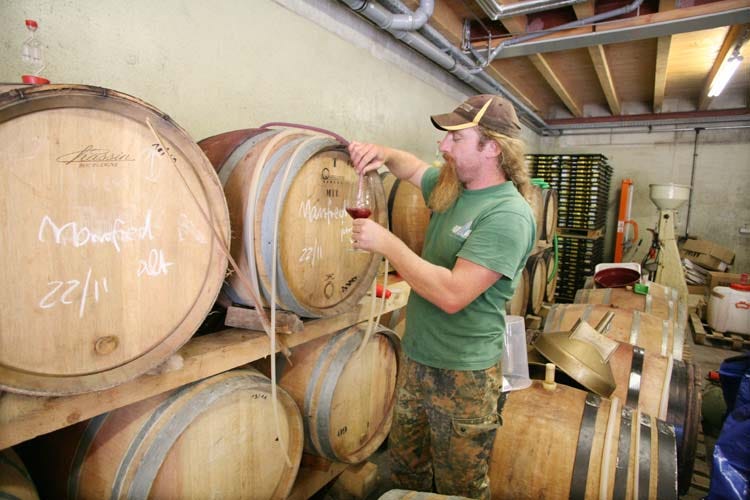
Tasting pinot noir from the barrel
Sven had me tasted a few wines from the barrel, all of their bottled pinot noir being sold out now.
__ Enderle & Moll rosé 2012. No sulfur added here, even on the incoming grapes as they were healthy. Nice dark color for a rosé. Nice tannin structure with meaty aromas, a bit of tickling on the tongue (still working). Usually they make one or two barrels of rosé only, one of the reasons being that they sell it much cheaper than a red pinot, and they need to make a living.
__ Enderle & Moll Pinot Gris 2011 rosé, from a small plastic tank. This was in a barrel previously and this small vat is an interlude before a bottling in magnums. Unfiltered. Crazy color, between orange and yellow, brought by the skin contac (between 24 and 36 hours). Nice wine.
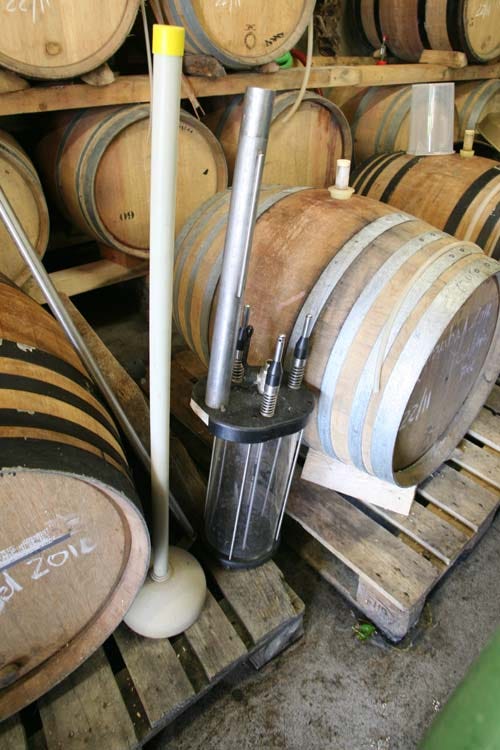
__ Enderle & Moll Pinot Noir 2012. the lowest cuvée of pinot noir, from a 10-year old vineyard, costs 10 or 12 € a bottle. No SO2 yet at this stage, and it will bottled unfiltered, keeping the lees at the bottom of the barrel. They bottle by hand with gravity using a 3-spout filler (pic on the side). Sven says that apart from 2 or 3 producers he doesn’t like the German pinot noir. Nice chew, hard to spit but I give the glass back to Sven so that he pours it back into the barrel.
__ Enderle & Moll Pinot Noir 2012, from older vineyards. The nose is more intense with fruit, still some gas. Savoury wine. They have 8 or 9 barrels of this. Sven says that they have one of the barrels that smells eggs right now but the structure of the wine is very nice, so they’re confident. The élevage time will be like usual between 12 and 15 months, without being moved, the leese depositing quietly. When the grapes ferment they don’t do pigeage or pumping over, they just push the cap down gently with the hands, and very little, almost nothing.
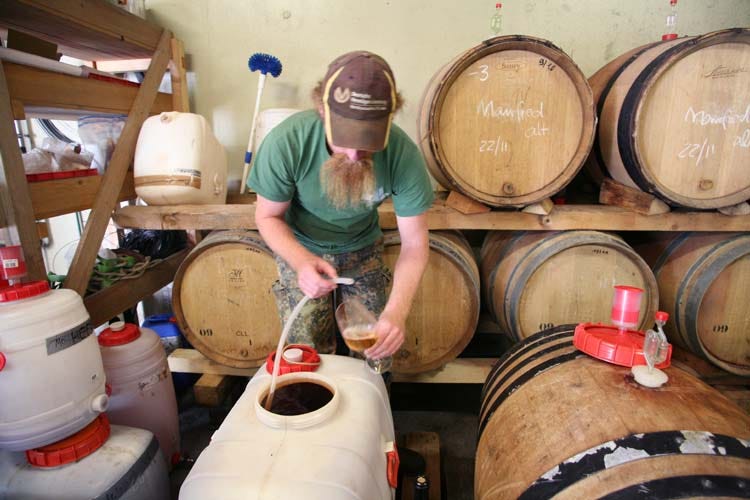
Pinot Gris 2011
They usually put 25 % of whole-clustered grapes in the bottom, then fill the rest with grapes. Sven says that speaking of Pinot Noir and Burgundy, he visited Claude Dugat there and he loves his approach and his simplicity, he was very open and welcoming which is not always the case for established, world-reknown vintners. His Griotte-Chambertin is unbelievable, he says. Also Sven says that Claude Dugat doesn’t make wine for money, he isn’t into the commercial drive.
__ Enderle & Moll Pinot Noir 2012, from a 55-year-old vineyard on sandstone, this is the top parcel on their domaine. Still a light fizzling feelm in the mouth. Very elegant wine with an impressive back of the mouth. Classy. Sells for 27 € to the end consumer here (14 € wholesale).
__ Enderle & Moll Pinot Noir 2012, from a half-hectare vineyard on limestone with low yields. Nose : vivid small red fruits. Aromas of griottes, these acidic cherries you make cakes with. This is the oldest pinot-noir vineyard in Baden (70 years if I remember)
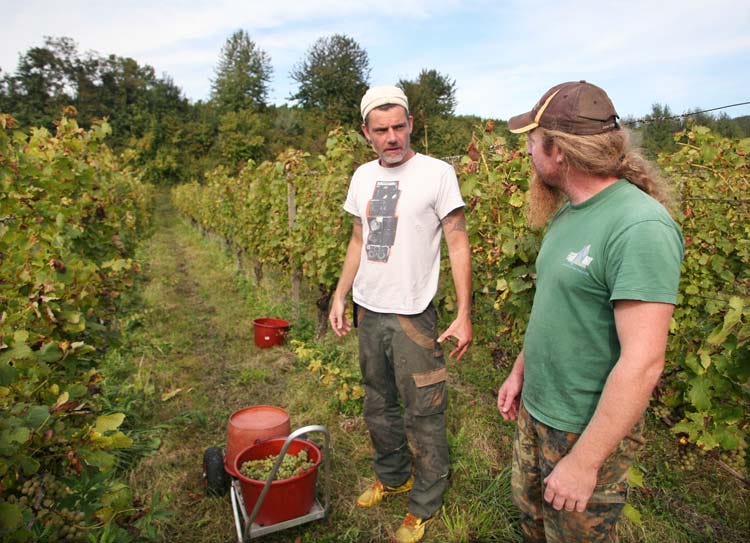
Florian Moll & Sven Enderle
We’re speaking about the prospects of working from an increased surface, when his friend manfred joins them with his 7 hectares, and Sven says that they’ll only have to care about the facility side, adding a side building to this surface cellar, because Manfred will take care of the vineyard management, something for which they trust him completely. They’ve already make some trials from his vineyards, making wine from this or that parcel and Sven says that it’s phenomenal. He and Florian hope to gradually work with his 7 hectares, depending the help they may receive from investors who trust them because they don’t have the money yet to offer security to the grower, and they have to build their customer base for this increased output before being able to buy 100 % of his grapes.
Until now he’s selling his grapes to the Münchweier-Wallburg-Schmieheim coop and it’s a waste because his high-quality fruits are melted into a sea of boosted grapes at the Badische Winzer Keller in Breiach, the 2nd biggest coop in Germany which sources from other smaller coops. These industrial coops may by the way notice that things are on the verge of changing because this grower will not sell them his grapes anymore, but it’s not sure they’ll make the steps to have their growers improve their farming. Sven says that on the other hand, there begins to be some thinking on this issue from the part of the best wineries. But ordinary producers see organic farming as more work and costs for less volume, and as they make wine more for money than from the heart, they won’t change for now. Sven says that he doesn’t judge but they have to make their own awakening on this issue. Right now there are only 10 to 15 wineries in the Baden region that are farming organic, that’s way smaller compared to Alsace on the other side of the Rhine river and where it becomes more widespread. Sven says that in Alsace he admires particularly Valentin Zusslin, also Pierre Frick or Rietsch and others. What he likes with Alsace is that there are many winegrowers there who are doing things differently, and it helps him and Florian to walk the next step. Their wines help you think and they tell stories. Still he considers that the Rieslings in Alsace are a little bit too thick, he prefers the sharp, acid and fresh wines of Mosel, Saar und Ruwer, they’re like a knife.
Sven told me some time later that there was a German vintner he loved the wines of enormously, it is Hanspeter Ziereisen who is located further south near Basel, he makes Chasselas, Gutedel, Chardonnay and Pinot Noir and Sven says his style of wine is outstanding for Germany, even when he works with minor varieties.
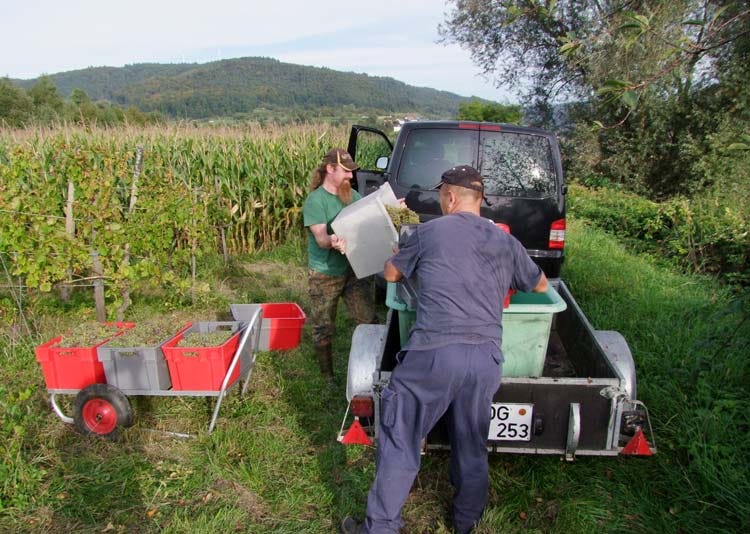
Loading the grapes
I follow Sven and the Romanian worker to the Hört parcel where Florian and about 7 pickers are busy finishing the harvest of the small parcel. With this picking at least they saved part of the load. They do not spray insecticides and rely on sexual confusion to drive away pests, and for some reason this didn’t work perfectly this time and they got these incidences of grape worms. The time window to put these brown plastic things with sexual-confusion materials is very narrow and a change of weather or miscalculation of the pest threat may make them ineffective. Plus the rot came, and even hardcore conventional growers got some. Sven and Florian look for a grape worm and finds one for me to see (picture below).
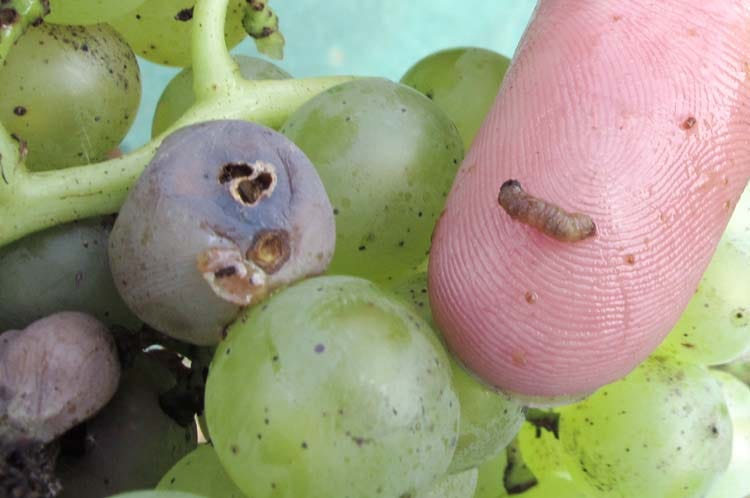
Sven says they can’t come to the idea of having to use poison to prevent these pests and they prefer to take the occasional risk of having an affected parcel like here. They still could save 50 % of the load on this Müller-Thurgau vineyard, which is not bad. He’ll spray exceptionally a bit of powdered sulfur on the grapes when they’re destemmed tp prevent the mold from yielding bad things on the juice.
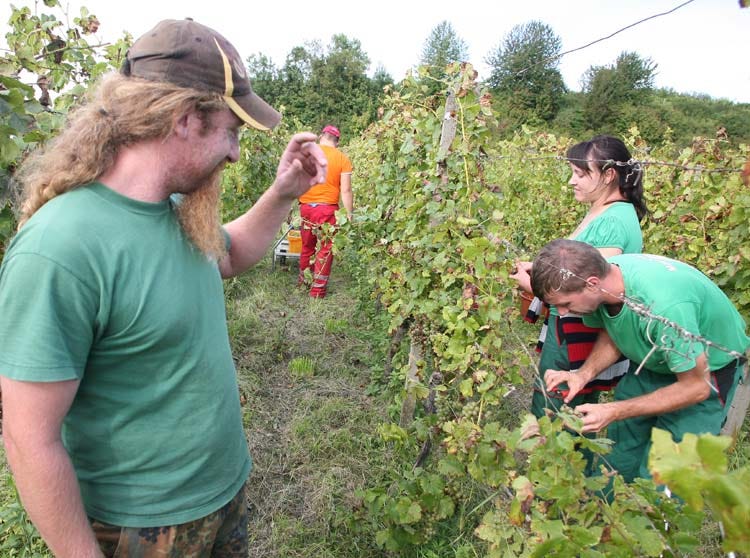
To pick the Müller-Thurgau they use much bigger crates than for the pinot noir.
This particular vineyard of Müller-Thurgau is not on a particularly good terroir, Sven says, it’s a part of Münchweier where there was terraces and slopes long time ago but bright minds who were in charge of the planning and of the remodeling of the agricultural lands in the region in the 1970s’ decided to flatten the surface with heavy machinery so as to make the vineyard easier to work, and the undersoil has been turned over and good vineyards were lost in the process. Happily, you still see terraces and slopes on other parts of the village land.
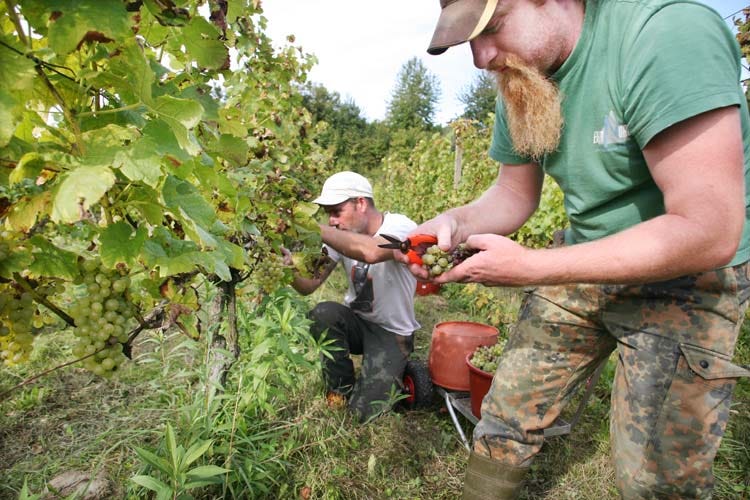
Florian and Sven picking Müller-Thurgau
After helping the Romanian workers fill the trailer at the back of the van, Sven Enderle tours me a bit around the village so that I can see a few of their other parcels. Speaking about the lower-rated vineyard of Müller-Thurgau that they're picking this day, he says that it's also good that they have such simple vineyards so that they can make a simple, good wine of it and sell cuvées at prices affordable enough for a thirst wine. Not all wines need to be Romanée Conti, and he considers that it's important to offer easy-drinking wines that are well made and at, say 10 €, wines that are healthy and nice without needing to be tasting like a Morey Saint Denis.
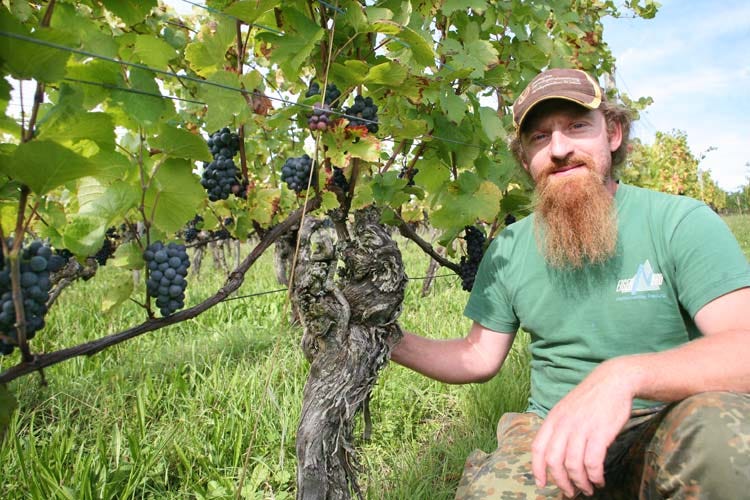
Old vines of Pinot Noir
We drive through the limestone terroir near Münchweier, where they have a 60-year old parcel of pinot noir. If you look at the color of the leaves here you can notice that they're relatively pale, especially compared with other parcels of pinot noir farmed conventionally, that's because the foliage isn't boosted by the fertilizers which turn the leavesa dark green. He says that a French winemaker told him that good leaves in a vineyard aren't dark green and also that grapes get a better potential if they go through a little bit of stress, it needs to fight and not get it easy.
This old vineyard was farmed until relatively recently by an old farmer who still used a draft horse, then it was taken over for a few years by a grower who did a very bad job for maybe 5 years, and Sven was feeling bad looking at the way this old parcel was tended, so he talked to the grower and asked to take over as he saw a great potential on this plot, and he works with these vines since 2009. They worked a lot to bring the life back into the soil, bacterian life and so on. It is because of the pinot-noir wine which they made out of this parcel in 2010 that people in Germany began to notice their work.
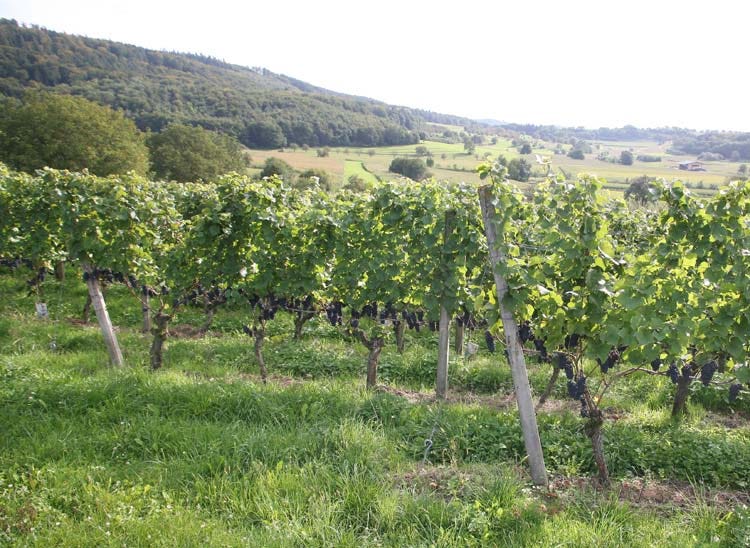
Manfred’s parcel of Pinot Noir
Very close from the old parcel we see a parcel of pinot noir belonging to his friend Manfred Enderle, that’s one of the vineyards they’re going to work with soon. Sven praises the excellent farming in his friends’ vineyards. Manfred is still giving the grapes to the coop right now. The training of his vines is conducted differently than theirs, and Sven shows me the differences.
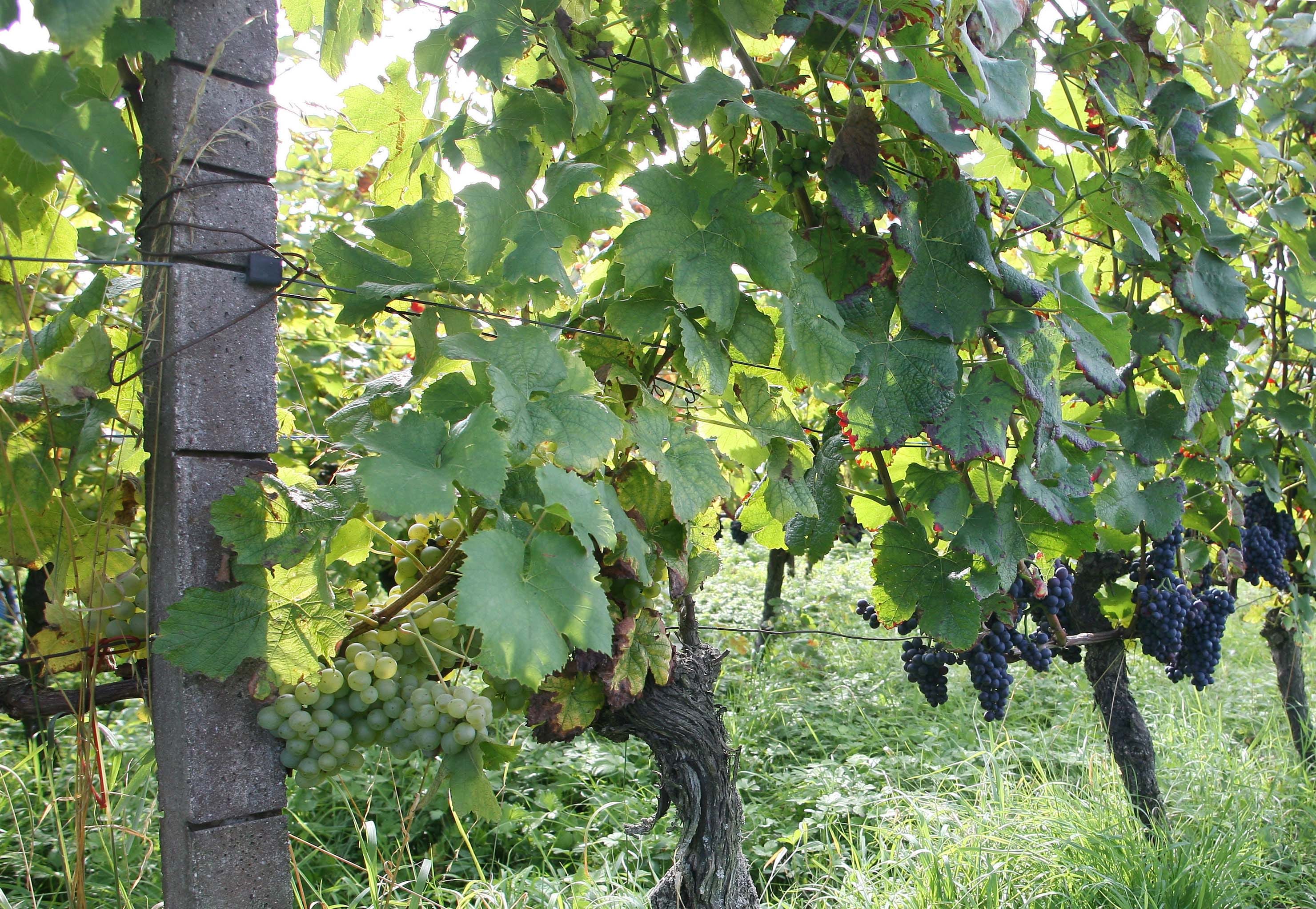
15-variety parcel
As we walk back to the van, Sven notices that the Romanian worker who accompanies us is eating pink grapes which he found in a complanted parcel belonging to Sven. I also taste some of these big pink grapes, it’s a great table variety, really delicious and no seeds at all in there it seems. It proves that farmers used here also to plant different varieties together in their parcels. Asked about the varietal name, Sven says it may be Muscatel, it’s very aromatic but not suited for wine. He says that this complanted parcel has no less than 15 varieties, there is everything in there like it used to be 100 years ago. Asked if they’re going to make something of this, he says that they made try last year but only 50 liters. My tip is, watch out for some atypical cuvée here, between red and white...
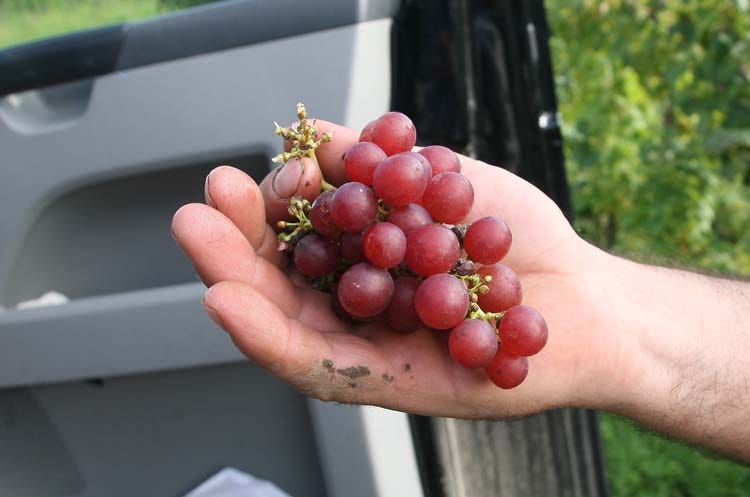
Table-grape Muscatel
Sven says that their vineyards always ripe sooner than the other vineyards around. The way they farm and tend their vineyard put them aside from the other growers, and they’re often looked down as strange growers doing strange things. At one point we pass a vineyard with red grapes, and Sven says that this is a color variety which is planted and used for the only purpose to darken the pinot noir wines. The growers get subsidies from the State for these grapes which have otherwise no value in terms of wine, they get no less than 6000 € subsidies for planting one hectare of such coloring varietal....
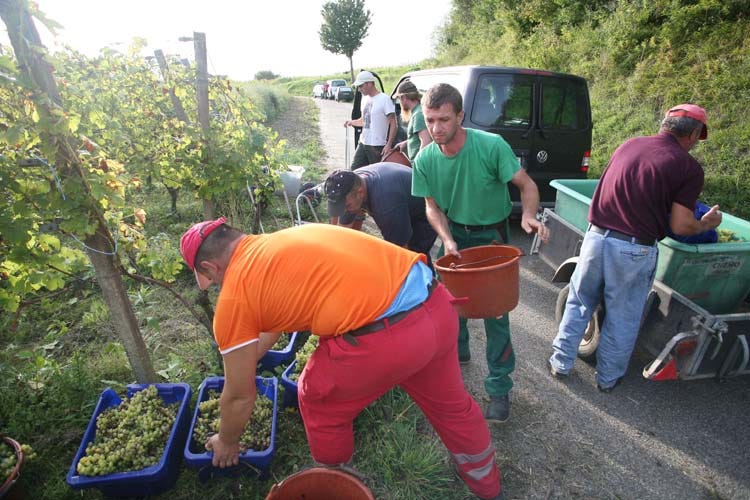
The last crates
As we were driving back to the parcel of Müller-Thurgau, Sven told me that he had heard about Jim Clendenen (he saw that I had made a story on him) when he was training at Bercher-Schmidt in Oberrotweil, Jim Clendenen happened to be a good friend of Franz Scmidt who was the vintner there, and each time Jim would come to Germany he would visit Schmidt. Sven says he remembers in 2003 when he was doing in his first days working and training in the winery, he saw that guy with long hair walking in and he wondered who he was, but he didn’t speak to him, it’s only later that he learnt about his work on Burgundy-style wines in California.
Sven says that there are 4 family wineries left in Münchweier when in the past every family would make wine. These other wineries have a surface of about 7 hectares each while Sven and Florian work on about 2 hectares, and the remaining surface which makes 65 or 70 hectares is farmed by growers who sell all their grapes to the coop. He says that here it’s different from the Mosel region or Alsace where family wineries grow and make wine from their crop, here it’s not Durbach or Kaiserstuhl, this region was a bit sidestepped over the years, the coops having the upper hand, but since he and Florian have made these wines which are so different from the average, the region gets coverage and noticed. Sven says that some growers even come to them to ask if they want to buy their grapes... Initially, Sven says, his goal was not to have a winery but to set up some sort of local cooperative making different wines from well-managed vineyards, but because of lack of financial backings, he and Sven opted for the individual winery. But with his friend Manfred joining them with his 7 hectares, there may be a chance to make something in that direction. And Sven says that actually the good size for a vineyard in ownership you have to work on is somewhere between 5 and 10 hectares, or maybe 7 to 12 hectares, this is the right balancve. He says he’d wish there was again 20 families working correctly on similar-size vineyards, he doesn’t want to take everything on himself and becopme yet another big winery.
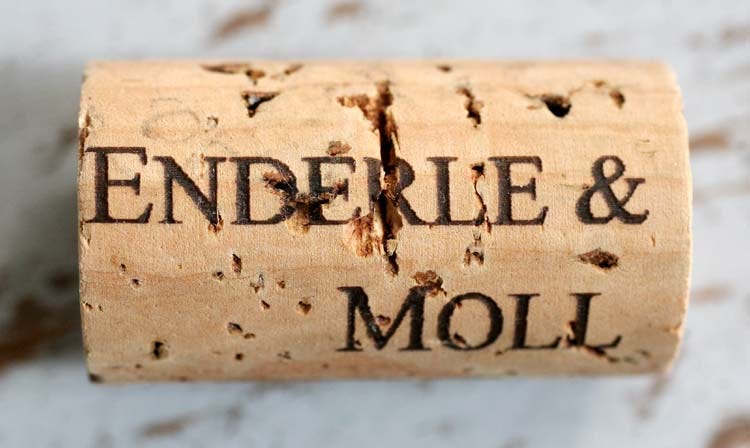
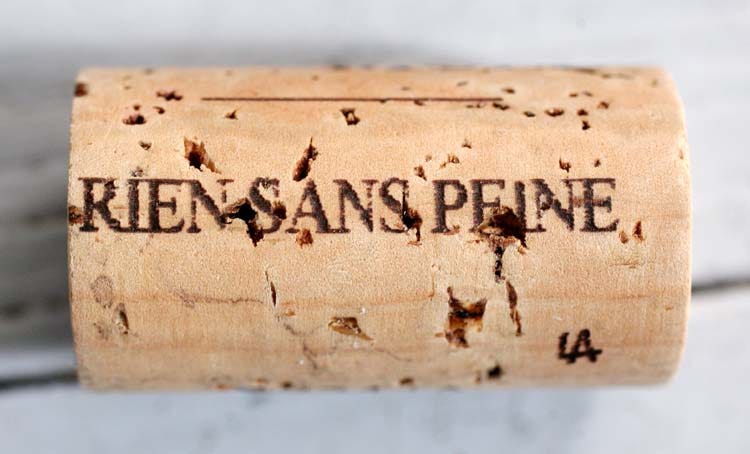
The few words (in French) printed on the side of the corks sums up well their philosophy at Enderle & Moll : No Pain No Gain...
Page with cuvées and prices
Chambers Street’s profile of Enderle & Moll
Lyle Fass’ story on Enderle & Moll
Lars Carlberg on Enderle & Moll Pinot Noir Liaison 2011
The magazine of the German Wine Institute (Overview of the German wines)
Weingut Enderle & Moll (Badische Zeitug - Auf Deutsch)
Sven’s interview for Baccantus (auf Deutsch 2010)
Die Freestyler von Münchweier (auf Deutsch -- Magazin für Essen und Lesen)
Enderle & Moll
4 Hinterhofen, Munchweier 77955
Baden-Wurttemberg
email : info [at] enderle-moll [dot] de
www.enderle-moll.de
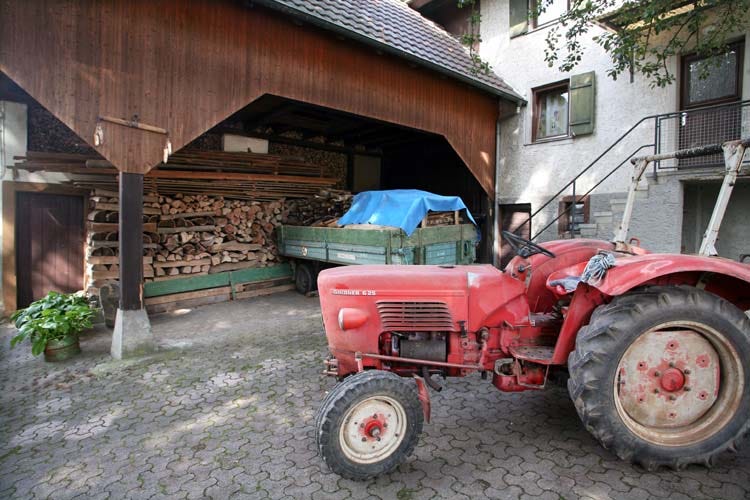
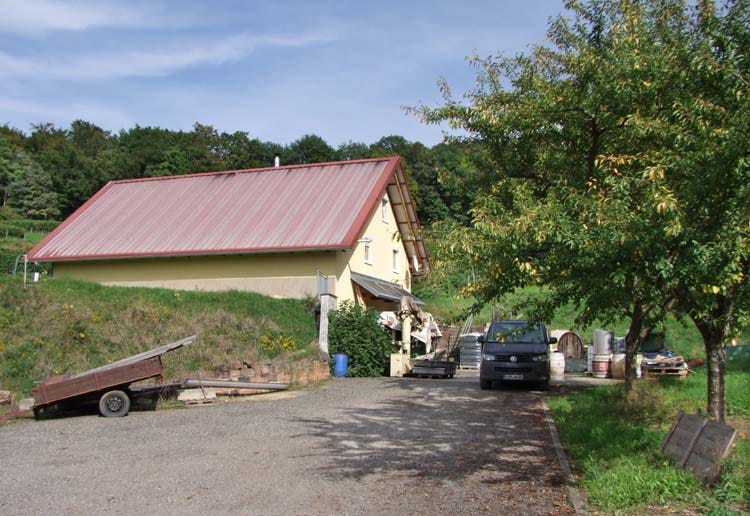
Farm courtyard in Münchweier