
Salon Rue89 (2nd edition)

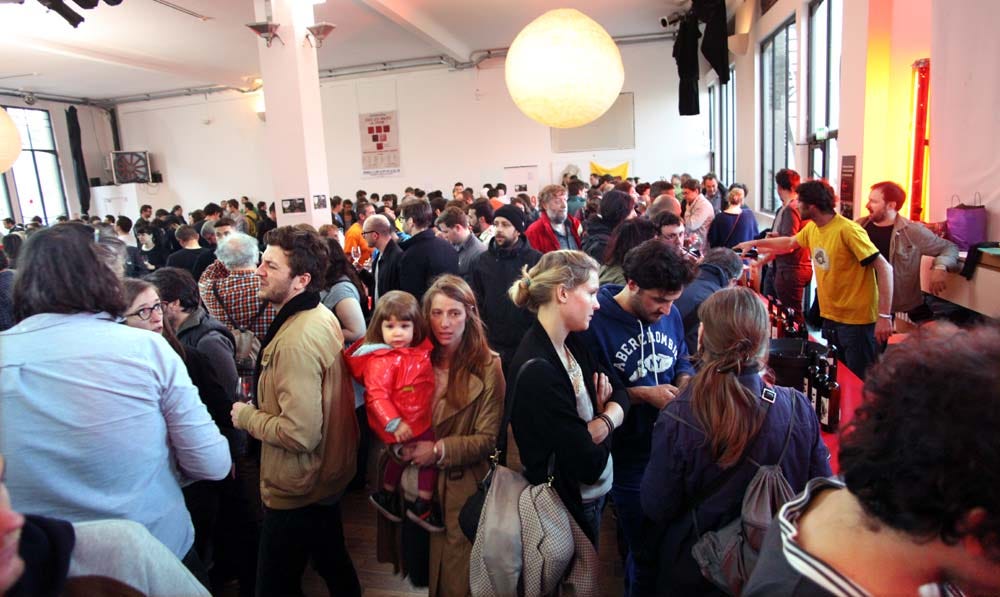
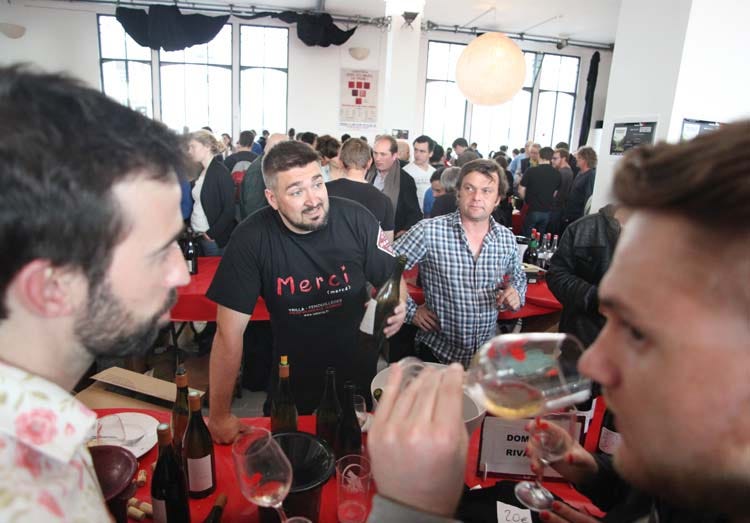
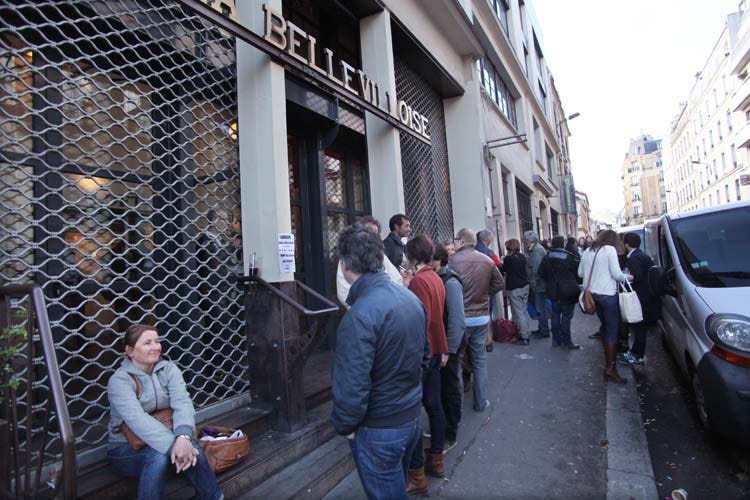
The crowd at the Salon Rue89
La Bellevilloise, Paris 20th arrondissement
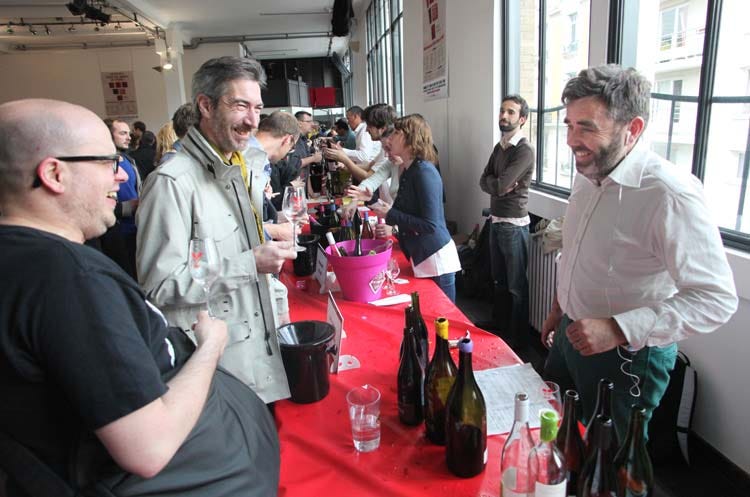
This is a story about a young tasting event (the first edition was last year) which is already attended by large crowds. You may notice in these few pictures that the average age of the visitors here is also much younger than for many similar artisan-wine tastings in Paris, hinting that uncorrected wine is beginning to widen its follower base and may reconnect the youth with the enjoyment of wine (we’ve been told for years that young people were forsaking wine in favor of beer and mixed spirits).
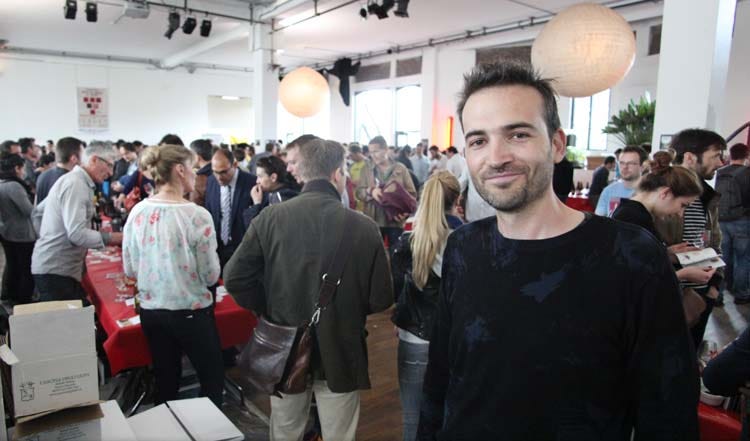
The artisan of this successful tasting event is Antonin Iommi-Amunategui (pictured on right), a young journalist who runs a wine blog at Rue89 named No Wine is Innocent. Rue89 is an information website created in 2002 by former journalists of Libération (a major left-wing newspaper in France). Rue89 retains some of the journalistic style of Liberation, with maybe more with a tabloid approach in addition to its political stance and the usual play on words in article titles, the latter being a trademark fixture of Libération.
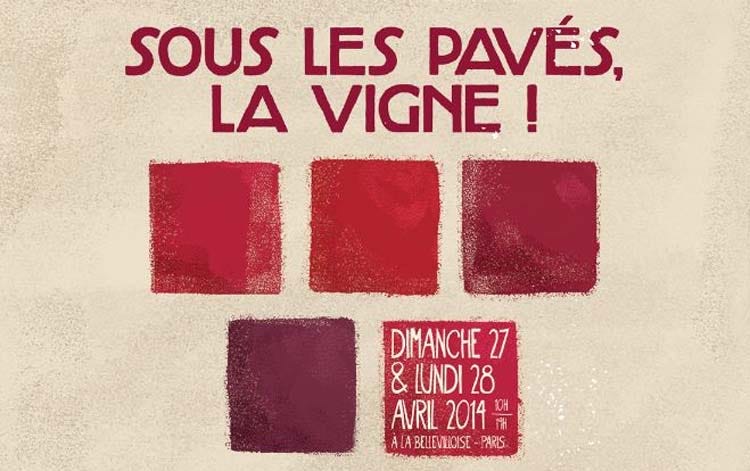
Antonin’s blog displays the same corrosive and politically-oriented style in his blog, the world of wine today having all the ingredients for heated discussions and opinions. He gives natural wine a good coverage, adding a fun and provocative edge that brought him a big readership in just maybe 2 or 3 years. After his blog took off, Antonin proposed to Pierre Haski (founder of Rue89) to try set up a tasting event with the participative style found at the news website, that is, with some debates to pepper it (this time for example they had a debate between Emmanuel Giboulot and Jonathan Nossiter). When the project took shape, the contacted winemakers were OK for the adventure, especially that thanks to the partnership between Rue89 and La Bellevilloise (the group managing this cultural/events building), the fee for the participating winegrowers was largely lower than the one asked elsewhere in Paris. The vignerons could also sell their wine to the visitors, so they could have an instant return on their investment and make ties with the young public at the same time. The motto for the tasting event was Sous les Pavés la Vigne (under the cobblestones, the vineyard), mirroring the 1968 slogan painted on the walls during the riots and cobblestone barricades of Saint-Germain-des-Prés in Paris, Sous les pavés, la PLage (under the cobblestones, the beach).
On the first such event last year, Rue89 helped bring the visitors in, using the news website, but this year the salon also got coverage on Le Monde and Telerama, which helped increase its popularity.
The salon invited for free in 2014 Edouard Fortin who lost much of his wine as the result of an arson at his chai.
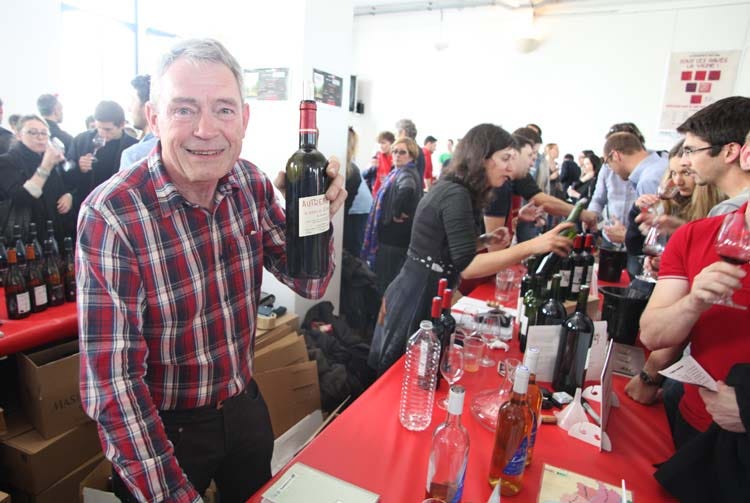
Jacques Broustet (Chateau Lamery)
The event took place the same day than the one of Le Rouge & Le Blanc (see earlier story), it was a sunday, it continued for another day on monday but because of my work I couldn’t attend, so having spent a long time at the Le-Rouge-&-Le-Blanc tasting, I could taste only at a few tables before closing time when I showed up in the late afternoon. The entry fee was 10 € and you could keep your glass afterwards, a nice tasting glass with two red glasses crossing in the way of the communist symbol of hammer and sickle.
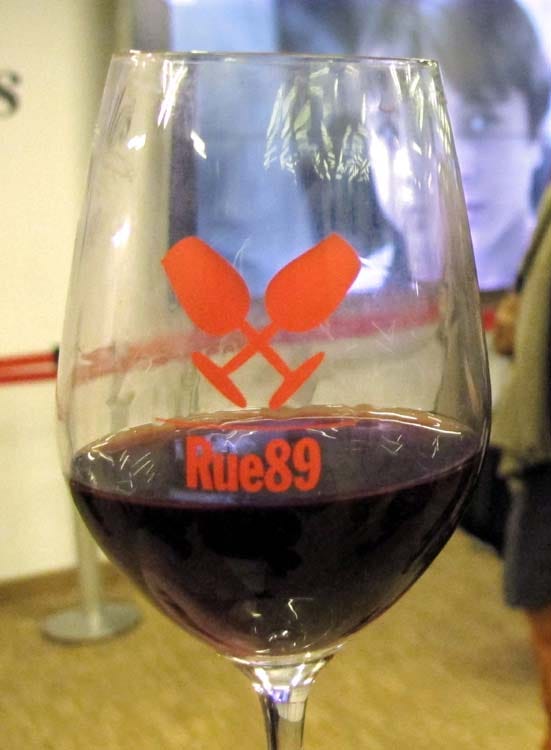
The logo seems to be both the trademark of the tasting event and the one of Antonin’s blog, in line with the revolutionary culture of Rue89. 50 artisan wineries were taking part (here is the list) but I could only taste a handful of them.
I first stopped at Chateau Lamery, one of the first tables when you walked in. Jacques Broustet manages one of the tiniest wine farms of the Bordeaux region, and certainly a very atypical one when you compare to the vineyard management and cellar norms over there. I discovered his cuvée Autrement a couple years ago and it was an awakening moment. Jacques makes only one or two cuvées from his small surface (2 or 3 hectares). He farms organic (Demeter certified) which isn’t simple in the Bordeaux region considering the rain and humidity along the year, he doesn’t filter, fine or correct his wine in any way.
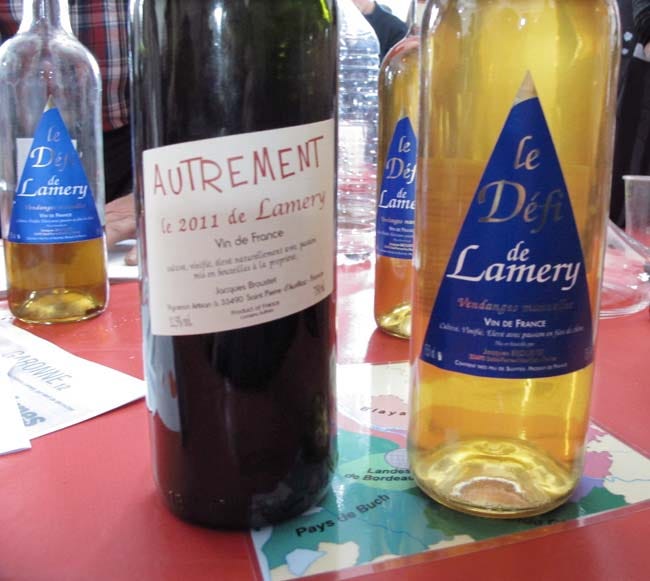
__ Chateau Lamery Autrement 2011, Vin de France (table wine). Autrement means different or differently in French, and it really shows a different Bordeaux wine, a glimpse about what many unexciting Bordeaux could become if the viticulture and cellar management was overturned. The wine is as delightful as when B. and I tasted it for the first time at Shonzui in Tokyo, it was a 2009 then, a vintage with higher yields at Lamery (his usual yields are around 25ho/ha) and this wine was a pure delight.
Jacques Broustet exports 70 to 80 % of his wine (foremost the U.S. through Garagiste in Seattle, and recently through Jeffrey Alpert Selections in NY), you can find it in many places in Paris, I remember having seen the bottle at Coinstot Vino for 15 € (price to go), a steal for the quality (He sells the cuvée at this price (tax included) today at the winery). Asked about the vinification, he says that for example in 2012, he destemmed all the grapes and vinified in cement vats for 3 weeks, then put the wine in old casks for 9 months, without disturning the wine in anyway there. Then, he racks in a vat for a few months and bottles on a fruit/lion day for optimum lunar conditions (in november usually).
__ Chateau Lamery Le Défi de Lamery, white wine (100 % Semillon). There’s some residual sugar, he acknowledges, from 5 to 9 maybe. He says he hadn’t put much SO2 and the wine refermented a bit after bottling
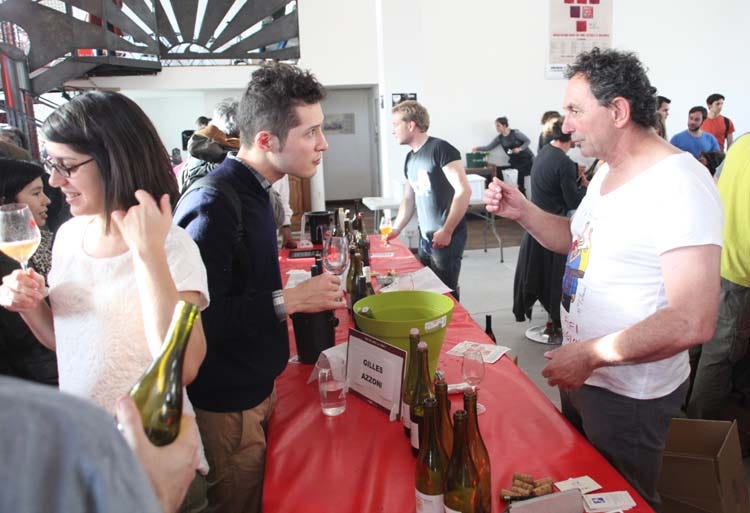
Gilles Azzoni
I walked along the alley trying to figure out whom to taste next, I always go to tastings with the firm determination to taste someone I don’t know, a new comer in the artisan wine or just someone I never tasted for some reason, and each time I end up stopping at vignerons I know because I can’t resist having a glass of their wine. This is the case again here, for Gilles Azzoni (Domaine Le Raisin et L’Ange) because his Rhône wines go down so well. You may notice how Aaron of Not Drinking Poison is listening acutely to the vigneron, he sure is a fan of his wines too. Aaron and I chatted later that day for the first time as he was chatting with Kenji and Mai Hodgson, we had had a few email exchanges but actually never met. He is an American expat and his blog is very good at profiling the wine restaurants in Paris (he can be tough for restaurants who aren’t up to the job) as well as the wines he comes accross.
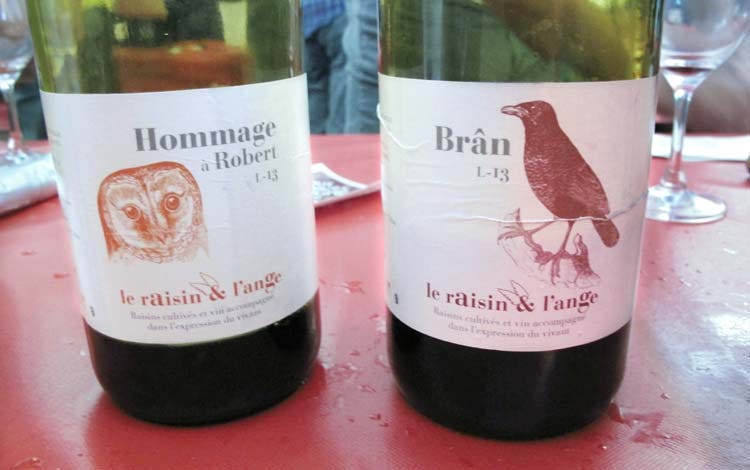
__ Hommage à Robert, (red) Vin de France (table wine) L 13. Syrah 65 %, Grenache 35 %, vines from 15 to 30 years. 11,5 % alc. Gilles Azzoni says that Syrah never makes high alcohol in their vineyards. The name of the cuvée is related to the former owner of the parcel who died in 2000. Nose : appealing meaty aromas. The wine has a thirst-quenching freshness that I appreciate each time I have one of his wines, red or white. Costs 6,5 € retail ! I bought a few bottles on the spot (could fit a box in the back on my motorcycle).
__ Bran, red Vin de France L 13. Caner,net 60 %), Merlot (15 %), Grenache (15 %) and a bit of Syrah. Bottled a month before like the other cuvée. Superb to swallow, a candy full of freshness. The empty glass smells like heaven. Costs 7,7 € retail (I grabbed another few bottles), how does he make to sell at this price ?
Jean-Christophe Comor
See, I am irredeemable and stopped again at someone I already knew the wines of, I need to discipline myself for this condoning comfort behaviour... But as an excuse the wines of Jean-Christophe Comor (Domaine Les Terres Promises) were such a nice discovery when I first tasted them in a region of Provence where I stay every year (central Var département), near Brignoles). Jean-Christophe Comor was a bit tired (he just returned from Brussels the night before) but he was still having a good time with the people at the table.
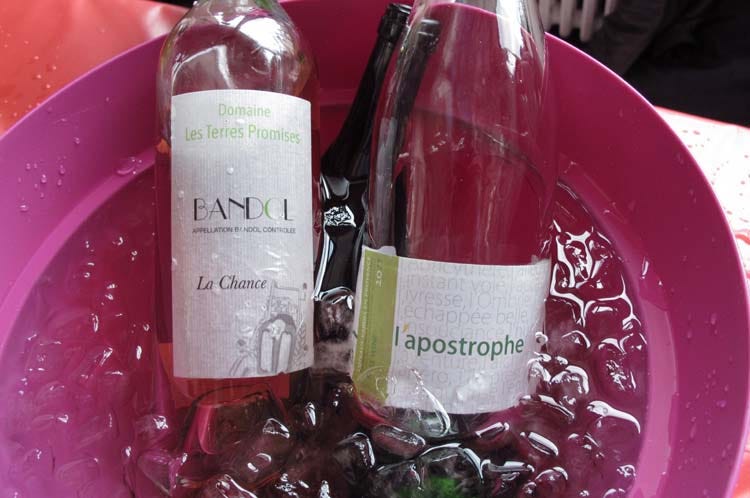
__ L’Apostrophe 2012, Coteaux Varois 2012. Rosé. Quite powerful, a rosé from Provence where you feel the sun.
__ Analepse Vin de France (table wine) 2012. White made from Carignan Blanc and a bit of Clairette. A southern white where power and freshness are yet well balanced.
__ La Chance, Bandol rosé 2013. This is lmy excuse for stopping here, he releases hiss first Bandol wines, made from vineyards he worked with in the previous years but couldn’t label as Bandol because he vinified the wines in Laroquebrussanne, near Brignoles in the inner Var. Now he makes the wine in a facility in the Bandol area.
Nice intensity in the mouth, with a saline minerality. He says that’s because the malolactic was completed and the wine sort of spits out its minerality. He works on 2 hectares in Bandol, both red and white. The total vineyard surface of his winery (most being in central Var) is 15 or 16 hectares now.
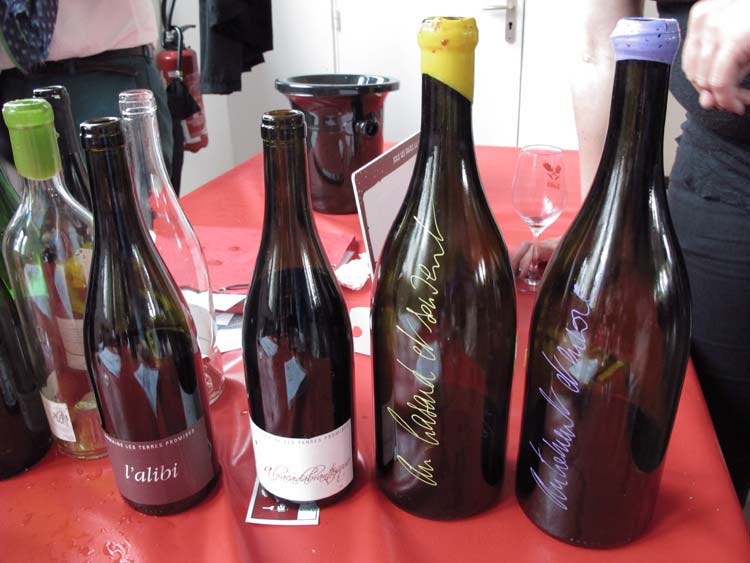
__ Autrement et Encore, Coteaux Varois 2013 (a magnum). Cinsault. Some astringency at this stage.
__ L’Antidote, Vin de Pays de la Sainte Baume 2012. 100 % Carignan. Generous nose full of promise, aromas of fruits and faded flowers. Mouth : light sugary side, with a saline side, an intense wine, very neat. Costs 10 € (tax included I think). Very good deal although a bit powerful for my spoiled Loire tastes.
__ Abracadabrantesque, Coteaux Varois 2012. Carignan-Mourvèdre with some élevage in casks. Still tight, the mourvèdre needs time to open. Go check this wine in a year or two, I’m confident it’ll be more at reach.
__ L’Alibi, Coteaux Varois en Provence [I think the “en Provence” was added by the wine authorities to augment the visibility of the AOC] 2012. Grenache-Syrah. Outstanding freshness (really no regrets for stopping at his table), along with the right tannin structure and natural elegance. And this is I guess just the beginning of the life of this wine... 13 % in alc. which is moderate under this climate.
__ Au Hasard et Souvent, Vin de Pays du Var 2013 (only in magnum). Old carignan vinified with carbonic maceration and blended with young Mourvèdre. Superb drinkability, goes down by itself. A magnum sells for 25 €.
Jean-Christophe Comor takes part to a group of winegrowers named Rouge Provence and whose goal is to highlight the potential of Provence to make great reds, the region making an overwhelming majority of rosé. Here is the list of the vignerons who joined Rouge Provence. Outside of Bandol, Provence is not considered a region for reds but when you taste Comor’s wine, you understand what we miss with this rosé débauchery...
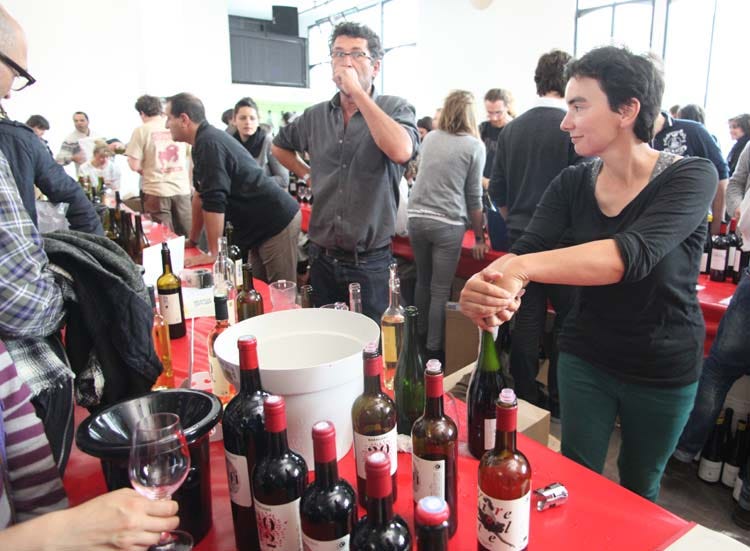
Laurence Alias
At last here is a Domaine I didn’t know, this is the Closerie des Moussis in Haut Médoc (Bordeaux), the domaine is managed by two women (Laurence Alias and Pascale Choime) who each had roots in the agriculture but in other regions. They looked for vineyards but it’s pretty out of reach in the region, and at the end they met the owner of an old vineyard through someone else and could begin make wine from this 1,5-hectare parcel. They settled in 2008 in Arsac and made their first vintage in 2009, it’s pretty recent. They work organic and wanted to work naturally from the start.
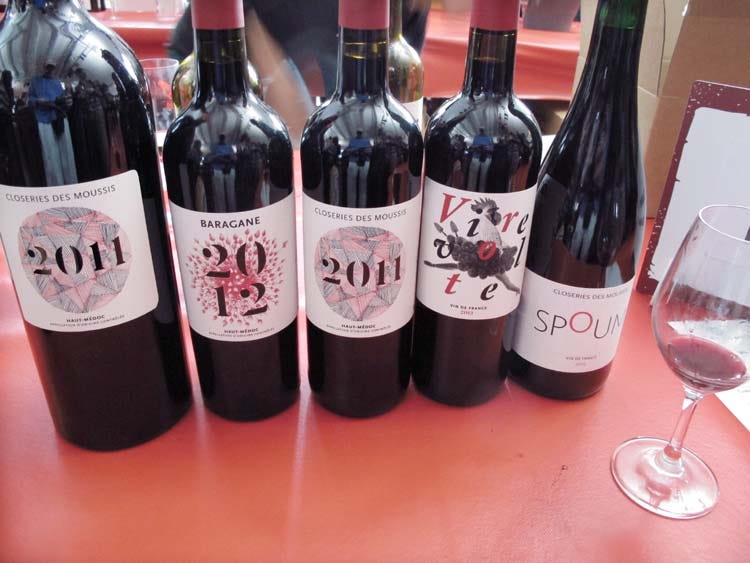
__ Spoum, Vin de France (table wine) 2013. Red natural sparkling (pet’nat). Color : turbid translucent red. No filtration Raspberry notes, surprising feel, easy drinking. 100 % cab sauvignon., that’s why a tannic frame. There’s an obvious candy feel here. 10,5 % in alc. Sealed with crown cap and wax (quite an elegant bottle). Costs 9 € retail and 5 € for professional buyers. 200 bottles only, for 2014 they hope to make 500 to 800 bottles of this.
__ Virevolte, Vin de France 2013. Merlot, Cab Franc & Cab Sauvignon. 11,5 % alc. Meaty nose. Here they just filtered grossly for big parts, but they didn’t do any fining. SO2 : usually between 20 to 50 mg in mid-élevage (at racking if I understand correctly). They may add some on the incoming grapes on difficult years. No notes for the tasting here sorry.
__ Haut Médoc 2011, Cuvée Classique, 70 % cab sauvignon, 20 % merlot and 10 % cab franc. 12,5 % alc. Vintage name printed in big letters on the label.
Mouth : a bit powerful for me, with astringency on the sides of the mouth. When they started they made only one cuvée, now they make one with the old vines and another cuvée for easy drinking (thirst wine).
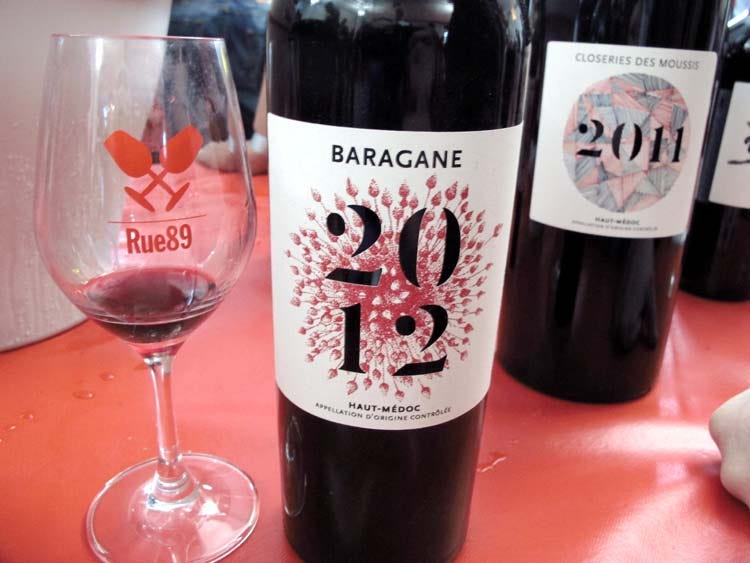
__ Baragane, Haut Médoc, Préphylloxerrique (ungrafted) parcel. 6 varieties in here, among which cab sauv, cab franc, merlot, complanted and vinified together. Superb wine, powerful too, but really awesome, it literally radiated through the mouth when you swallow. The soil is not sand here (often considered safe against phylloxera) but silts that are often flooded, which I guess the phylloxera doesn’t like. They have a 40-are surface here and make 700 bottles out of it. The bottle sells for 27 €, very good deal, you’ll love Bordeaux wines.
Read this good profile on the Domaine by Ideemiam.
Vincent Balansa
Vincent Balansa is the man behind the Domaine la Boria, a a winery located in Trlla on a high plateau east of Perpignan. Vincent is also the man who started Projet Bio Trilla, a participative project where passionate amateurs can share the develoment of a winery and the rebirth (on organic grounds) of a small village named Trilla in the middle of a remote part of the Roussillon in southern France, the area around the village being the Haut Fenouillèdes.
Watch the video on the left where shareholders (co-vignerons) explain why they joined this participative winery (beautiful landscape with the village of Trilla in the background). [Still looking for this vide ….]
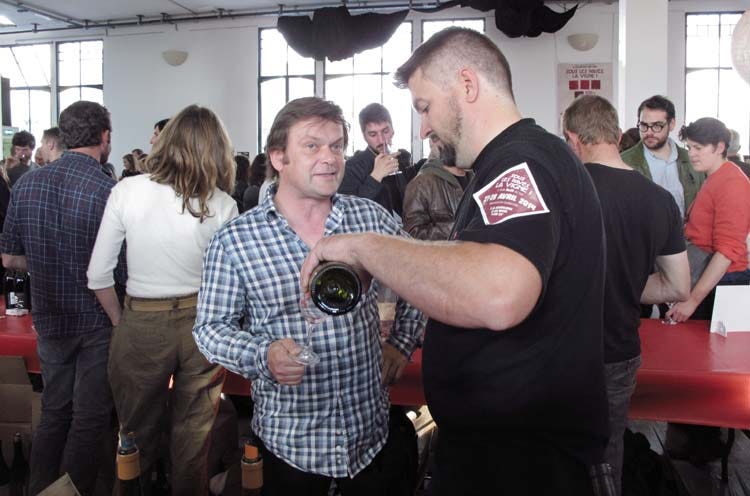
__ Felhuns 2010. Turbid white wine, freshness already on the nose, and life feel. Aaron joins me among the crowd of wine amateurs, there are so many people at the table that I can’t hear what the guy says. Macabeu mostly, with some grenache. Very mineral.
__ Trilha 2010, Syrah on granite, marls and gneiss. Color : turbid and chalky. Mouth : delicious and intense, very beautiful, to try absolutely.2,5-month maceration, zero SO2. 22 € retail. Empty glass : so good. 4000 bottles.
__ Les Arcolans 2010 (not sure of the spelling), from the vat (brut de cuve), not bottled yet. Elevage of 3,5 years, 110-year-old carignan. Nose : superb, and what freshness ! (or minerality maybe). 900 bottles. Will sell between 40 and 50 € retail. Exceptional wine, worth the price if you can afford.
Picture above : Vincent fills a glass for Frédéric Sigonneau of Domaine de L’R.
Aurélien Petit
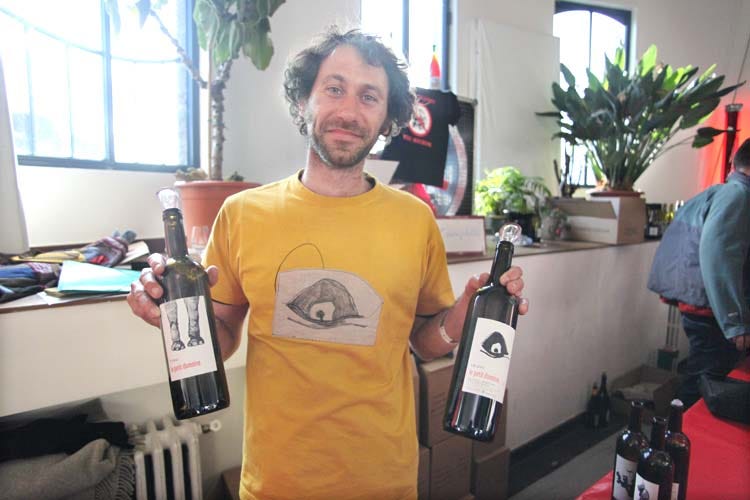
I stopped at this table on the advice of Aaron, if I read correctly my bad writing. Aurélien Petit set up his winery (Le Petit Domaine) in 2012 in Montpeyroux (noth-east of Montpellier) in the Herault département (Languedoc). He works on a surface of 4,8 hectares the organic way and vinifying naturally in the cellar, with indigenous yeast. He and his partner Julie Brosselin have been doing a very good job in barely two years, taking part to Vini Circus (a major tasting event with natural wines) and now Rue89 (Follow them on Facebook).
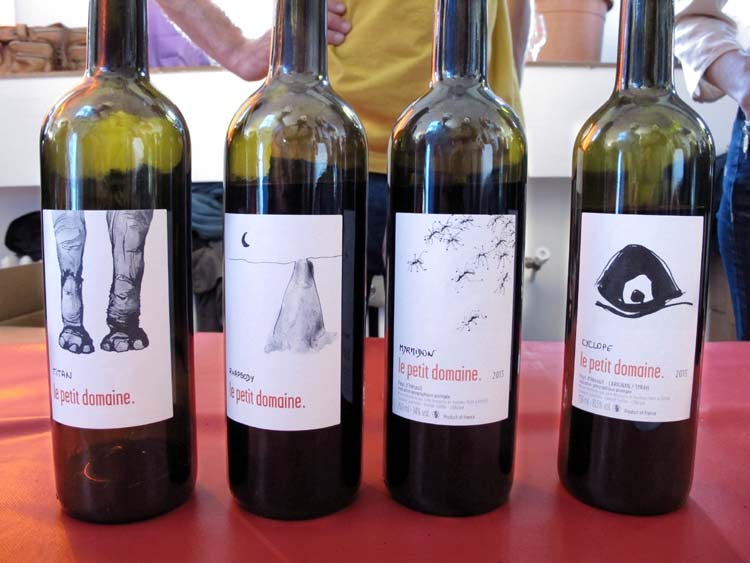
__ Cyclope 2013, Pays d’Hérault IGP. Carignan-Syrah. This is the end of the day and after all these wines (some being swallowed I admit unrepently) I begin to have trouble emitting an opinion. Not bad, beyond the sugary side here.
__ Myrmidons, Vin de Pays de L’Hérault 2013. 100 % Syrah, 14% alc. The mineralityis so strong here that you may mistake it for tannins. Very interesting wine, although a bit powerful for me, especially at this time of the day.
__ Raphsody 2012. 100 % carbonic maceration of Carignan-Syrah. 1000 bottles. Meat-juice nose. Wine with minerality and saline notes. Very focused. 21 €.
__ Titan 2012. Majority of Syrah with a bit of Carignan. Elevage in casks. 1000 bottles. Also very concentrated with this mineral and salty feel. Quite good. 24 €. In general their prices go between 9 € and 12 € tax included even if a few cuvées cost more.
It was closing time and Antonin was telling gently to everyone through the loudspeaker that the event was over, we soon reached for the exit.
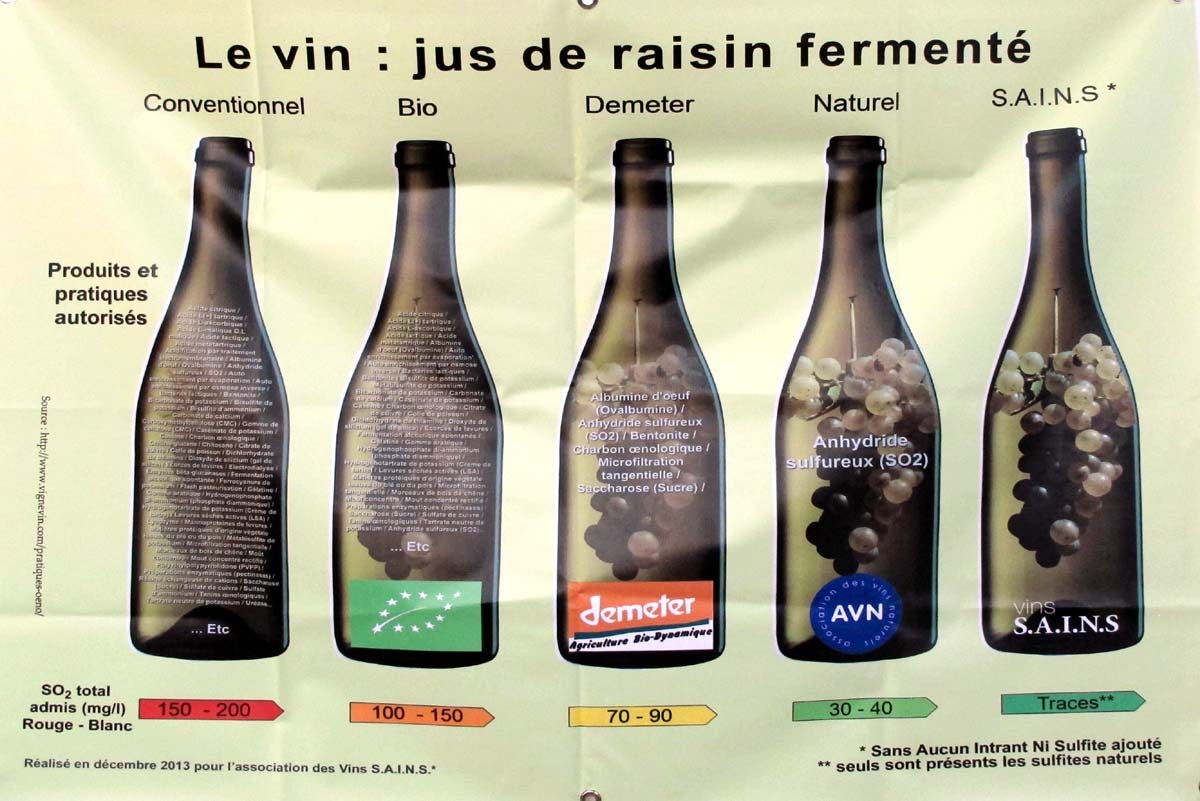
Poster with comparative list of additives in wines
This poster above was particularly interesting for the visitors who weren’t aware of the different practices regarding additives use in the wineries (even in France, few peple know that wine is corrected through various tricks, most still believe it’s just always fermented grape juice).
On the left you can read on the bottle for the conventional wines all the allowed additives and corrections, the list of products and methods is so long that it ends with etc... Then the next bottle lists all the additives accepted by the European organic certyification (almost as much stuff...), then you begin with the serious wine, namely the demeter-certified wines where a few things are allowed (although rarely used I think) and from what I read on this Demeter-USA document (page 38 to 42), the sugar addition which is listed on the poster as allowed is not allowed by the Demeter-USA rules. Then lastly, the A.V.N. and Vins S.A.I.N.S. certifications where nothing at all can be added (except a bit of SO2 for the AVN). And many vignerons make natural wine along the rules of these last two groups, even though they didn’t formally joined the certification.
Cruising through the crowd
On this video you can have a glimpse of the ambiance, very young folks indeed. At one point at min 00:58 you’ll briefly see Jonathan Nossite (I didn’t realize this was him, busy as I was filming and checking the frame), and later Thierry Puzelat chatting with Sébastien David, Frédéric Sigonneau and others including Kenji and Mai Hodgson...